
A Court of Fear and Impunity
ICE wants you to know they will kill you, and there’s nothing you can do about it. Here’s how to stop them.

My mother called me with a request. My little brother lost his job when the small business he worked for folded, and he has a special needs child, a baby, and a wife to support. After a lifetime of struggle, my brother is also among the ranks of angry YouTube- and podcast-influenced MAGA men.
He wanted to join ICE because it pays a $50,000 signing bonus. He could use the money, and he’s ex-military, so I get it. But he has a tricky legal issue that is preventing the hire. My mom wanted me to work some magic and fix it—finding lawyers who had my skill and connections for handling it was otherwise evading him, especially because he doesn’t have extra resources right now.
I had major qualms. First of all, I’m married to an immigrant. The current anti-immigrant, anti-civil rights behavior of our armed government is terrifying us on an existential level—not just insulting, but deeply scary. My husband’s a naturalized citizen with no criminal record, but that’s only mildly reassuring.
Second, I don’t want my brother in ICE because I think he could get hurt. The violence is escalating, and I don’t want him in domestic combat. Third, I had to wonder: would helping someone join ICE be aiding and abetting America’s Schutzstaffel? Assuming that’s what I believe it is, and that belief is rational, what was my moral culpability?
I didn’t voice these concerns because my mother wouldn’t have understood them. And since there’s not much I would deny her, I said I would think about it.
When I hung up, my husband said, “You’re going to do it, aren’t you?”
“Probably,” I replied, with a grimace. The legal constraint on my brother wasn’t fair, and he needed a steady job and healthcare for his family. I was sympathetic. So I worked out a legal strategy.
But after completing hours of prep work, I decided against it. My decision was based on the third reason. I’d help him get any other job, but I wouldn’t help him join our SS. That was a month ago.
In the pre-dawn hours last Thursday, I couldn’t sleep. I’d been in a horrid flare for days and hadn’t been online in at least forty-eight hours. At 3 am, I opened Facebook.
The very first thing I saw was a slow-motion video of an ICE agent shooting someone in her car. I saw him pull out his firearm and take three shots—two through the open driver’s side window. Her SUV accelerated and crashed into another car across the street. The agent sauntered off, adjusting his face mask upward. Then I saw a still photo of the bloody interior of the car.
I gasped.
I hadn’t read the news while offline, and I was unprepared for this unbidden video. As a matter of habit, I avoid violent videos of true events. For two decades, from the beheadings of journalists to the shooting of Charlie Kirk, I’ve intentionally missed them all.
Shocked, I felt my chest tighten and tears prick my eyes while I searched for the news about what I’d just watched. I soon learned the victim’s name: Renée Nicole Macklin Good.1
ICE vs. The Constitution
For the next several days, online spaces raged. More videos emerged—some with sound, from varied angles, showing the context before and after. Particularly awful was the video of her wife sobbing on the snow with their dog.
It is my professionally informed opinion that ICE agent Jonathan E. Ross committed murder.2 But that’s not what this article is about. Plenty of others have dissected and analyzed this homicide. Rather, I want to discuss the larger context because this was the inevitable result of what Secretary Kristi Noem, her colleagues in the Trump administration, and her deputies have purposefully put into place.
After watching the video, the first thing I posted on Facebook was this:
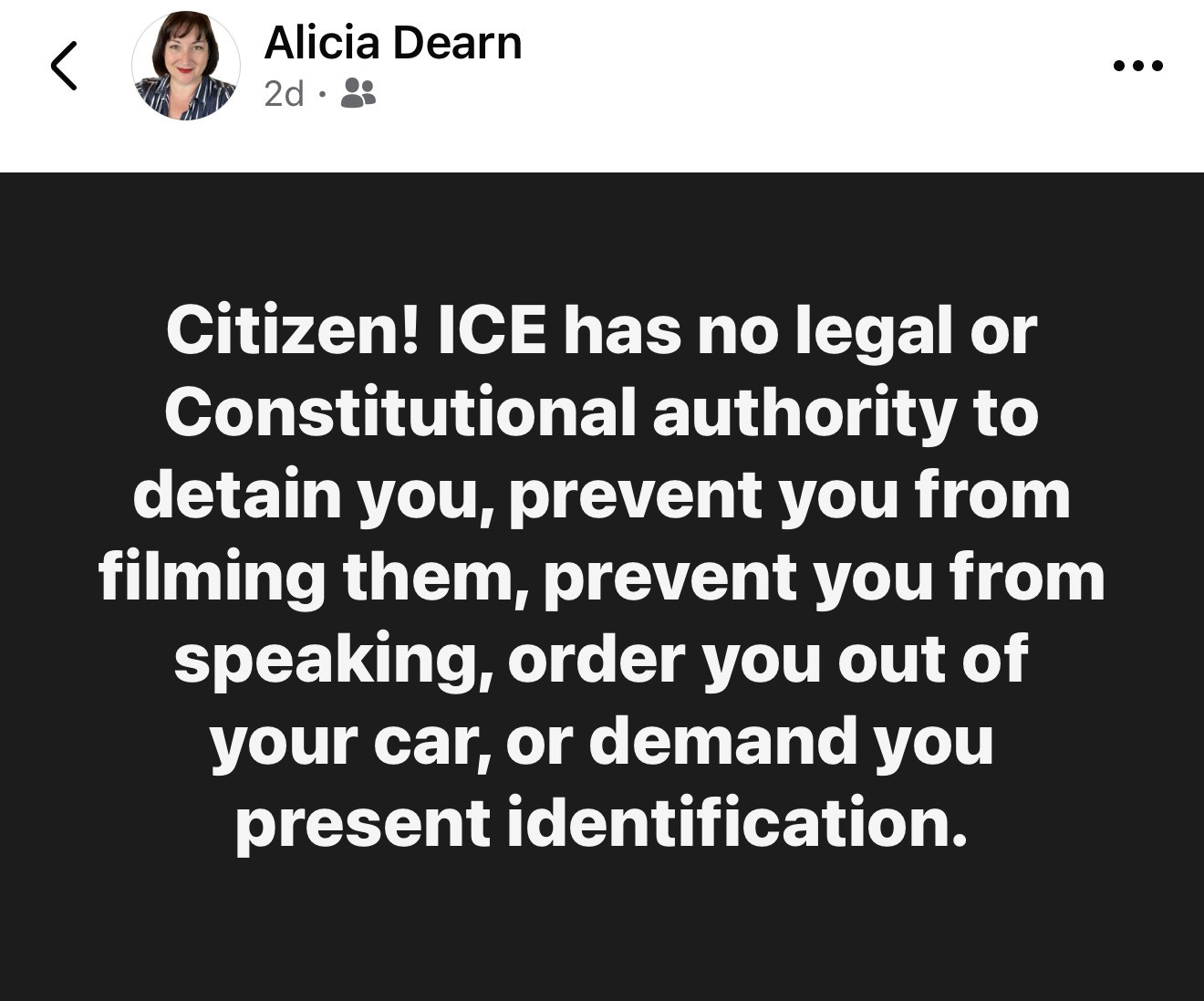
Generally speaking, law enforcement cannot:
Stop you while driving without reasonable suspicion that you are committing a crime
Enter your closed private property (home, vehicle, business) without permission or a warrant
Demand you present identification3
Prevent you from exercising free speech, even if you are insulting and upsetting them
Prevent you from occupying open public spaces, like sidewalks, streets, parks, and buildings
Prevent you from filming them
Stop you from leaving unless you are explicitly under arrest
Stop you from accessing legal counsel
Force you to talk to them if you don’t want to, including forcing you to show them your phone or any documents and devices you are carrying
Use deadly force, like shooting at you, to stop you from leaving or fleeing
Search or frisk your person or property without a warrant, an arrest, or reasonable suspicion that you are currently committing a crime while armed and dangerous
Physically accost you in any way
These rules apply to all law enforcement, including the local police. ICE is even more restricted, because it exists for the discrete purpose of arresting out-of-status immigrants. ICE’s primary authority is civil immigration enforcement (per the Immigration and Nationality Act, 8 U.S.C. § 1357), and they lack general police powers over both citizens and non-citizens—especially over citizens. That means, in addition to the above, ICE cannot:
Pull over cars or interfere with and direct traffic
Break into cars or jump in front of moving vehicles to arrest drivers and passengers
Assert any authority over citizens whatsoever
Arrest, detain, or demand citizens (or anyone who isn’t an out-of-status immigrant) exit their vehicles4
Search anyone who isn’t an out-of-status immigrant or their property
Use force on anyone who isn’t under arrest, except in strict cases of self-defense
Enter private homes and businesses without a warrant and especially after being told to leave
And yet, we have all seen videos of ICE repeatedly:
Entering private property (including businesses) and refusing to leave
Giving orders to citizens and lawful residents to stop, exit their car, provide papers, answer questions, move, provide access to property, stop speaking, or stop filming
Breaking into vehicles (especially by breaking windows), and snatching at the occupants
Moving in front of operating vehicles
Using tear gas, pepper spray, tasers, and firearms when no imminent threat of bodily harm is present
Arresting citizens
Transporting people away from counsel, courts, and home jurisdictions, and detaining them without due process (including citizens)
Depriving people of life, liberty, and property without due process of law
Charging people with obstruction, only to see those cases repeatedly be dismissed by grand juries, judges, and trial juries
There’s some nuance—particularly around what ICE calls “obstruction”—and I’m getting to that. But as a practical matter, nearly everything we’re seeing ICE do right now is unquestionably out of bounds under the United States Constitution (and state laws apply too).
You and What Army?
Hear me clearly: My legal summary of your civil rights isn’t controversial or speculative. Constitutional law isn’t theoretical or underdeveloped. Anyone supporting ICE who says that ICE is operating legally and constitutionally is gaslighting you.
Rather, DHS leadership and the Trump administration know ICE agents are breaking the law. They have, in fact, instructed them to do so. They’re intentionally violating people’s civil rights, and betting you can’t do anything about it. Here’s why they made that calculation.
1. They Believe in Hard Power
Recently, Stephen Miller said, “We live in a world ... that is governed by strength, that is governed by force, that is governed by power. These are the iron laws of the world since the beginning of time.” He made this statement in reference to the U.S. attacking Venezuela, but his view on power isn’t limited to our foreign adventures. He’s also asserted that President Trump has the power to do anything he likes domestically.
Stephen Miller is a white nationalist who believes in ethnic cleansing through mass deportation. He’s not hiding it. And Miller is one of the architects of current DHS operations.
Miller does not stand alone. More broadly, the philosophy that power is primarily exercised through brute force is daily demonstrated by the Trump administration. The administration secures supplication through leverage, harassment, threats, controlling and cutting off resources, litigation and prosecutions, and even deploying troops in our cities.
So it is no surprise DHS operates on brute strength first, the Constitution never. The leadership of DHS does not value principles (civil rights) above purpose (exerting their control). They also do not fear enforcement of the law against them; since Noem took over, DHS has outright ignored multiple court orders—because the courts do not have guns. DHS has also massively increased its spending on militarizing ICE with weaponry and armor. Noem now turns those weapons inward—to show the population who’s in charge.
ICE wants you to fear them. Convincing you they will shoot you on contact is the point. Eliminating resistance through intimidation is the goal. And it’s working: immigrants are fearful. Many have left the country voluntarily. Many more have turned back from their attempts to come here (legally or illegally), and international tourism has severely retracted. The Trump administration wants the citizenry who support immigrants to be fearful, be silent, passively accept ICE’s violence, and let it operate with impunity.
It’s correct for me to say, “ICE can’t legally detain, accost, or murder you.” But being correct will mean nothing to you when you’ve been shot dead. It’ll mean nothing to ICE when there’re no consequences for shooting you dead. And once everyone knows this, the population will cower.
2. So Sue Me
a. Civil Suits for Constitutional Violations by ICE
If the police violate your Constitutional rights, you can sue them for money damages. Lawsuits against federal law enforcement for violating your rights are called Bivens actions, so-called after Bivens v. Six Unknown Named Agents of Federal Bureau of Narcotics, 403 U.S. 388 (1971).
In 2022, the Roberts Supreme Court abruptly limited the application of Bivens against the Border Patrol in Egbert v. Boule, 596 U.S. 482 (2022). No Bivens suits against the Border Patrol, it decided. The Supreme Court determined that the Border Patrol engaged in national security operations. Because national security (like the military) is different from law enforcement (like the FBI), Congress needs to pass a law specifically allowing the Border Patrol to be sued for Constitutional violations.5
But there’s a difference between the Border Patrol and ICE. The Border Patrol operates on the border, as its name suggests, and has long been quasi-military, like the Coast Guard (which is also under Homeland Security, not Defense). The Border Patrol doesn’t just check passports; it interdicts smugglers, traffickers, and terrorists. That’s why they are hardened. In contrast, ICE operates domestically, and historically has not been militarized. Its purpose is to find and arrest people who have violated immigration and customs laws. They operate under warrants, like law enforcement. Indeed, “enforcement” is literally the E in ICE’s name.
Under Noem, ICE has been transformed into a quasi-military force domestically, which is why they’ve been outfitted with sophisticated weaponry and armor. The highest levels of management at DHS and the Trump Administration now claim that ICE is for national security, like the military, instead of law enforcement.
While Egbert technically addressed the Border Patrol, DHS aggressively applies its logic to ICE amid this new national security framing. DHS expects the Supreme Court to eventually extend Egbert to all of its operations—meaning that you cannot sue them for violating your Constitutional rights without Congress intervening. Noem et al. believe Congress will not intervene, and the net result will be that it can operate under de facto absolute immunity.
This is of course terrifying because now ICE is acting like, and essentially claiming to be, an occupying force domestically. This is why the comparison to Nazi Germany’s SS isn’t hyperbole. The SS was a domestic quasi-military organization responsible for internal security, policing, and enforcing “racial purity” policies—all while operating outside normal legal constraints. ICE is claiming the same framework.
b. Personal Versus Agency Liability
Here’s another important piece in understanding the chessboard. Normally, when you sue for your rights being violated under the Constitution, you sue the agents who violated them, not the governmental agency they work for. Bivens actions are against individual agents.
This is because the government has sovereign immunity. America’s legal system is based on the English system of yore. The English can’t sue their king (the sovereign). Inheriting this principle, we can’t sue the government (sovereign immunity) unless the government agrees to it first.6 This agreement was provided to a limited extent when Congress passed the Federal Torts Claims Act, which allows you to sue when the government commits torts against you. The FTCA still applies when ICE commits torts against you, but there are a lot of limits procedurally and damages-wise.
You can sue the government for Constitutional violations. Constitutional violations aren’t torts, so these suits are not governed by the FTCA. Unlike torts, when you sue the government for Constitutional violations, you sue for injunctions. Injunctions are court orders that prohibit or require things. They are not money damages, and that’s why they are allowed despite sovereign immunity.7
In short, if ICE violates your civil rights, you can sue for a court order to make them stop and not do it again. But that doesn’t fix the harm that has already occurred—damages are how we do that, and damages aren’t available when sovereign immunity applies. There have been no FTCA-like laws passed by Congress to allow you to sue the federal government directly for damages for Constitutional violations (unlike Bivens actions where you sue the individuals, not the agencies).
That is why injunctions are most useful in class actions. If ICE violates your rights, and you represent a class, you can make ICE not do it again—not just against you, but also against other people. By mid-2025, DHS was being enjoined all over the place—although they were outright ignoring the injunctions and sending planes of people to El Salvadorian gulags, anyway.
With the courts aggressively upholding the Constitution with nationwide injunctions, the Trump administration made a beeline to the Supreme Court, crying national security. Normally the Supreme Court doesn’t jump so quickly, but they did for Trump all throughout 2025. Worse, this was against a backdrop of a long and contentious legal debate about nationwide injunctions—which I will not bore you with. The upshot is that nationwide injunctions are now unavailable in most cases, thanks to Trump v. CASA, Inc., 606 U.S. 831 (2025).
Without Bivens suits, and injunctions being piecemeal and outright ignored, lawsuits against DHS are unlikely to concern anyone there—no one will have to pay tort damages out of their own pockets when DHS is sued under the FTCA.8 Bivens suits are more effective because when individuals can be sued and held accountable for damages, they worry a lot more about not violating your rights in the first place.9
With DHS officials telling their agents that they’re absolutely immune from suit (not just qualifiedly immune), they have told them there are no civil consequences for breaking the law. This has made the behavior of individual ICE agents unconstrained, and has incentivized them to follow illegal directives from their superiors so they don’t lose their jobs.
3. Who Jails the Jailor?
Without intrinsic motivation to follow the law at DHS, or extrinsic motivation through private lawsuits, we’re left with the criminal law. Murder is still a crime. But will anyone prosecute?
a. The DOJ Is Currently Lost
When Renée Good was shot, Noem, Vice President Vance, and even President Trump, all responded before an investigation could be conducted, aggressively claiming the shooting was justified. Vance went further and announced that Ross (and all other ICE agents) will be protected by the Trump administration and not charged with crimes when they use deadly force. The FBI Director, Kash Patel, immediately took control of the investigation and locked Minnesotan authorities out.
Once relatively infrequent, since Noem took office in January 2025, federal immigration agents have been involved in an increased number of domestic shootings. As of publication, there’ve been sixteen shootings and four confirmed deaths, with several of the victims being citizens. Beyond these shooting-specific figures, there’ve been thirty-two deaths in ICE custody, making 2025 the deadliest year for the agency in at least two decades.10
Despite the concerning body count, no ICE agents have been prosecuted by the DOJ. Worse, leadership within the DOJ’s gutted Civil Rights Division immediately informed staff they will not pursue any investigation of Ross’s murder of Good.11 The DOJ will not enforce the criminal law against ICE personnel involved in these deaths.
That said, the Trump DOJ will not be in power forever. And the federal statutes of limitations for serious crimes (murders, assaults, kidnapping, torture, and corruption) are five years at the shortest, with some being unlimited. Declining to investigate and prosecute now doesn’t serve as a future bar. Prosecutions may happen eventually.
b. The Obstruction Smokescreen
Shooting citizens in broad daylight is bad PR and carries the danger of civil uprisings if people become too provoked. While it’s hard to imagine in current America, when uprisings become fervent enough, they turn into coups, civil wars, and revolutions. Hard power practitioners, like the Trump administration, seek to cow the population and push the limits as far as they can without inciting violent rebellion.
To paint a veneer of legitimacy, confuse the public, mire court proceedings, and openly punish dissenters, DHS claims “obstruction” in every conflict. To ensure the broader population gets the message that they must not object to anything ICE does, Noem claims large swaths of the citizenry are engaged in “domestic terrorism” or criminal obstruction, and threatens violence and prosecution. The accusation is victim blaming, and intimidation.
To be clear, obstruction is an actual crime. Forcibly preventing an ICE agent from carrying out their legitimate duties is illegal. For example, if you see an ICE agent arresting someone pursuant to a warrant, you can’t tackle the agent so the arrestee can flee. You can taunt, refuse to assist, passively resist, film, mock, and shame them.
But, as used lately by DHS, the “obstruction” accusations are plainly frivolous—and you don’t have to take my word for it. The DOJ is repeatedly failing to secure convictions. The “obstruction” and “domestic terrorists” accusations do not create a legal justification for ICE to harass and abuse the population.
c. State Prosecutions Offer Hope
One avenue remains: state criminal prosecution. States can prosecute federal officials who commit crimes within their borders. There’re centuries of precedents for this, with the modern framework in place since 1890.12 Federal employment doesn’t grant automatic immunity from state criminal law—despite what the Trump administration is telling its people.
Admittedly, DHS will fight prosecutions aggressively. They’ll assert Supremacy Clause arguments, claiming that the agent’s actions were permissible under the Immigration and Naturalization Act and powers granted to the President for national security. They’ll remove the case to federal court, complicating the litigation. And the DOJ will provide the legal defense, so the accused will not go bankrupt with legal fees and will not be financially incentivized to plea bargain.
But here’s what matters most: bail.
If a state prosecutes an ICE agent, that agent gets arrested and then attends a bail hearing. For serious charges like murder, attempted murder, kidnapping, or assault with a deadly weapon, bail can be denied or set prohibitively high—especially if the defendant is a flight risk, or an ongoing danger to the public (like continuing in their job while exhibiting an unapologetic propensity for violence).
Which means the agent could sit in jail for months or years while the DOJ fights to get the case dismissed on Supremacy Clause grounds (federal removal doesn’t mean that bail conditions will automatically become more lenient—especially when the Trump administration is concurrently seeking stricter bail rules). And that’s all before their lawyers prepare for a trial on the merits—the DOJ’s litigation will require waiver of the right to a speedy trial.
Even if the case is eventually dismissed or they are ultimately acquitted, agents face the realistic prospect of serving real time pending trial. That’s a deterrent with teeth. ICE agents might think twice about shooting citizens if they know they could spend years in pretrial detention while lawyers argue about federalism, procedure, and evidence. We should be sure to tell them.
So What Do We Do?
The Trump administration is betting on fear, impunity, and our meekness. They think the Constitution is just words on paper when agents have guns and the DOJ has their back. But history shows that fear only works if we let it. We can break that bet—starting right now, right where we are.
1. Friends Don’t Let Friends Join ICE.
If someone in your life is eyeing that $50,000 signing bonus or thinking the uniform means power, remind them: this job isn’t just about enforcing immigration law anymore. Under Noem and this administration, it’s become domestic combat with escalating violence and no real accountability. Agents like Jonathan Ross are being sent into communities armed like soldiers, told they have “absolute immunity” (a lie), and facing genuine risks—from public outrage to the possibility of state charges and years in pretrial detention. Don’t romanticize it. Don’t help them sign up. Help them find something else—anything else. Loyalty to family and friends means keeping them out of a machine that’s turning citizens into targets and agents into villains.
2. Teach ICE Agents That Accountability Isn’t Dead, Just Delayed.
The current DOJ won’t touch them. But the Trump administration won’t be in power forever. Federal statutes of limitations for serious crimes give us breathing room. Declining to prosecute now doesn’t erase the crime—it just postpones the reckoning. Future DOJ leadership could revisit these cases, especially with the body of evidence building from videos, witness statements, and public records. And that’s without considering that the states can prosecute at any time they see fit. We should educate ICE agents about their incarceration and lawsuit risks.
3. They Can’t Kill All of Us.
The most powerful weapon we have is outnumbering ICE. If the U.S. Army struggled to occupy the much smaller Afghanistan, then it’s obvious that a less professional, recently militarized DHS can’t forcibly hold the United States when her citizens decide against it.
Stand up and resist. You can do this by gathering evidence. Film every encounter. Document victims’ stories and share them widely. Shame and name violators publicly. Protest, resist civilly, organize vigils and noise demonstrations. Refuse hospitality. Encourage your local district attorneys and attorneys general (all elected officials) to prosecute, and volunteer evidence.
In 2025, the Trump administration famously sought to “flood the zone” with legal violations so that they could not be curtailed by overwhelmed courts and pro bono law firms. Flip the script and flood the zone with videos of peaceful people suffering from the jackboots until the rest refuse to look away.
A word about antagonizing ICE: I won’t tell you, “When they go low, we go high.” Outrage at oppression and injustice is human and valid, and I share the frustration that overly polite (or perhaps corrupt) politicians have let a strongman bully the world. But, strategically, consider what you get for verbally antagonizing ICE. On one hand, you’ll get the fleeting satisfaction of letting them have it. You’ll also invite violence directed at you.
On the other hand, you won’t convince any ICE agents that they should quit (which they can, at any time) by screaming insults at them. Your videos and witnessing (which is needed for prosecutions, lawsuits, and online counter-education) will lose credibility because people will attack you. By all means, voice your displeasure—just be smart about it.13
4. Be The Best Witness You Can Be
If ICE stops you, speak the magic words: “Do you have reasonable suspicion that I’m committing an immigration crime?”
It would be extra useful for all the civil rights lawyers who want to help if you video their responses.
If they say yes, then say: “Please articulate why you have reasonable suspicion that I’m committing an immigration crime.”
When they can’t provide reasonable suspicion, say: “You have no authority over me and I’m not required to cooperate. I choose to exercise my constitutional rights to not speak with you and to leave … or to film, speak out, protest, and passively resist ICE presence in civilian spaces.”
Bystanders should call local law enforcement to ask for help de-escalating and supervising ICE activities. Local police can also serve as witnesses.
5. Keep Suing. Something Will Get Through.
Civil suits are harder than ever, but they’re not dead. Persistent litigation can chip away at the system and make agents think twice. Even if victories are piecemeal, they create records, force discovery, give us injunctions, and build precedent. Every filing reminds agents they’re not untouchable. And perhaps Bivens will end up applying to ICE after all.
6. Support Civil Rights and Immigration Lawyers.
These attorneys are on the front lines, often working pro bono or subsisting on infrequently won contingency fees. It’s impoverishing and stressful. We do it because the need is overwhelming, and we are called to serve. Groups like the ACLU, NILC, and local immigrant rights organizations are also drowning in cases. Donate, volunteer, spread their know-your-rights materials. Courts may be slow and inefficient, but they’re the strongest existing bulwark against the “iron laws” of fascists. Bolster them.
7. Replace Congress (Both the House and Senate).
It’s a big ask to replace them, but it’s essential that Congress begins to represent the people once again. Congress has the power to rein in DHS, restore oversight, defund militarization, and protect rights by letting individuals sue for constitutional violations. They won’t do it so long as they are more afraid of Trump or their lobbyists than they are of the voter.
Educate your friends and family, campaign for candidates who prioritize civil liberties over enforcement theater, and vote like the future depends on it.
8. Lobby Your Governors To Assert States’ Rights
The United States is still a federal republic. That means that the state governments have the ability to refuse the federal government in many circumstances. People often think that the Supremacy Clause means that the Federal government can assert its will over the states whenever it chooses. That’s emphatically untrue, and even our current Supreme Court still mostly considers federalism (the concept that the federal government has limited, enumerated powers) to be sacrosanct. When the governors of California, Oregon, and Illinois told the President that they did not want the National Guard activated in their states, the federal courts—all the way to the Supreme Court—backed them, and the President had to withdraw.
A Court of Fear and Impunity
Halfway through writing this essay, I felt such despair that I worried I wouldn’t be able to offer any useful advice. I’ve understood what was happening legally all along, and rallying hope has been difficult for the past year. There are no shortcuts. There are no Marvel superheroes coming to rescue us.
If we want to defeat those who would subjugate and abuse us, we must do it collectively, through a thousand paper cuts, through the audacity of being brave and immovable in what is right.
When setting up their Court of Fear and Impunity, Miller, Noem, Vance, et al. bet the population would cower. Let’s prove them wrong.
We’re Americans, after all.
This essay was written a few days before the murder of Alex Pretti. I was equally horrified by his execution by Border Patrol.
I’ve practiced civil rights law for nearly 25 years, including both suing and defending law enforcement in use-of-force cases and constitutional violations. I’ve litigated § 1983 claims, qualified immunity defenses, and Fourth Amendment violations through trials and appeals. My opinion derives from my legal expertise and the extensive evidence available to the public.
There is some nuance here. You can be required to present identification if you are under arrest, operating a vehicle on public roads, crossing the border, and in some other circumstances depending on state law. But generally speaking, America isn’t a “show me your papers” country.
More precisely, ICE can arrest people, but only in limited circumstances. The arrestee must be actively committing federal crimes in the ICE agent’s presence while the agent is performing their immigration duties. But as a practical matter, this isn’t what’s occurring—they’re not stumbling upon bank robberies while on duty. Indeed, most crimes are not federal crimes because the criminal law mainly falls under the states’ jurisdiction. To get around this, ICE is calling (frivolously) everything “obstruction” to claim their victims are federal criminals.
The reasoning for this is long, complicated, and dry. So I will spare you. Please just trust me that this is so.
Sovereign immunity enjoyed by the government is absolute immunity. When you sue individuals who work for the government, they enjoy qualified immunity. Simply put, the duties they carry out for the government are immune from suit to the same extent the government is immune. But actions that exceed their proper authority are not immune. Violating constitutional rights is illegitimate behavior so long as it is a clearly established right that the federal employee should know about. Qualified immunity adds an extra layer of proof that can be hard to reach.
Sovereign immunity for equitable actions was waived in the Administrative Procedures Act, and judicial review is directly available under Marbury v. Madison, 5 U.S. 137 (1803).
The US Government has unfathomably deep pockets, and lawsuits are rounding errors. Individual agents can be sued personally for torts, but they are indemnified by their employer for regular damages. Punitive damages are disallowed under the FTCA.
You might wonder: can’t you sue DHS itself for damages related to unconstitutional policies—not just torts? In lawsuits against state and local police, you can sue the department for unconstitutional policies (called Monell claims under 42 U.S.C. § 1983). But § 1983 only applies to state actors. There is no equivalent federal statute allowing damages claims against federal agencies for unconstitutional policies. You can only sue for injunctions—which, as explained, are now limited and routinely ignored.
https://www.theguardian.com/us-news/2026/jan/07/trump-immigration-ice-shootings
https://www.cbsnews.com/news/doj-civil-rights-division-will-not-investigate-minneapolis-ice-shooting-sources-say/
In re Neagle, 135 U.S. 1 (1890).
Again, this was written before Border Patrol shot and killed Alex Pretti. It is never appropriate for the federal government to shoot and kill people who are not an immediate threat to their lives (aka self-defense), no matter how offended they are by that person’s speech or behavior. This advice is purely practical because your life is valuable and ICE agents are acting dangerously towards protestors.
Thanks for reading Posts From the Edge.
If you’d like to support the research and time that goes into my writing, you can drop a tip in my Ko-fi jar. It’s never expected, but always appreciated.
I think it’s important to note too, that with a new administration, many of the DOJ protections that these ICE agents currently enjoy will also, likely, go away. So while the Trump administration may provide legal counsel to ICE agents who did the administration’s bidding, a new Democratic administration seems more likely to leave that financial burden to the agents themselves.