
What Power Do Judges Have?
Will We Follow the Law, or the Law of the Jungle?

On July 13, 2023, I published a novel titled Conduct Unbecoming a Judge. The main protagonist is a Federal District Court judge in San Diego. This character has a case where the Department of Homeland Security harms eighty-five thousand immigrant children. They are sued by the ACLU, and my fictional judge makes rulings that the DHS willfully evades. After she threatens contempt, politicians attack her in the media, leading to violence. At the contempt hearing, the DHS minimally complies, leaving her in a quandary.
Here’s an excerpt, and I’ll let the story speak for itself:
The enormity of the number hit her between the eyes again. “Eighty-five thousand babies,” she mumbled, looking at her balled-up fists. She jumped out of her chair as emotion swept through her; she was about to veer horrifically into conduct unbecoming a judge.
“Five-minute recess. I’ll be back.” She stormed out of her courtroom and jogged to the bathroom in her office, locking the door. Sitting on the toilet, she sobbed into her hands, because nothing she ordered would cause those children to be found, or those bureaucrats to care.
She splashed water on her face and calmed down. Throwing the DHS’s bureaucrats in jail was politically fraught and unlikely to result in anything positive. The best she could do was order the DHS to pay every cent of the ACLU’s legal fees. Heaving a resigned breath, she went back to her bench.
When she returned, her courtroom was remarkably silent, given the crowd. Feeling shockingly powerless, she made the appropriate orders and ended the hearing. She had nothing left to give the law that day.
I’m not Nostradamus. The ways judges can be evaded by litigants, especially the executive branch, is obvious to experienced lawyers. Also, the case fictionalized in my novel was based on a real scandal spanning multiple administrations of both parties. (At the time of publication, Biden’s DHS was on deck and Missouri’s Republican Senator Josh Hawley was investigating.)
Without diving too deeply into theories of power, both legitimate and illegitimate, it is simply a fact that society requires people to agree to be civil in order to function properly. For the most part, people agree to the rules, and that is to our mutual benefit.
In the case of the United States, the most fundamental set of rules that everyone has agreed to is the Constitution. Public servants (from judges, to law enforcement, to bureaucrats, to the President) all swear an oath to uphold it.
It’s the bedrock of our civil society. Most of us revere the Constitution. And most of us find it shocking when someone lies and breaks their oath to faithfully uphold it.
When there are no mutually agreed rules—no written and predictable laws that we all submit to—we devolve into the Law of the Jungle, namely, the most ruthless person with the most strength, controls, to the detriment of everyone else.
Do not underestimate the seriousness of the moment.
One of our rules in the Constitution is that we have courts. Those courts decide the law and facts in disputes both major and minor. It’s as close to fair as we can currently get, and everyone here has a right to access them. (Everyone means everyone, not just citizens, not just the rich and powerful, not just people who’ve never done anything wrong.)
The Judicial Branch is an essential, and co-equal, part of our government. The courts vow to adhere to the Constitution and the laws made by Congress. The rest of government (including, especially, the executive), and we the people, agree to comply with the decisions of the courts.
Without this last part, the law is whatever the person with the most power (guns, money, ruthlessness) says it is. Or as President Trump sees it:
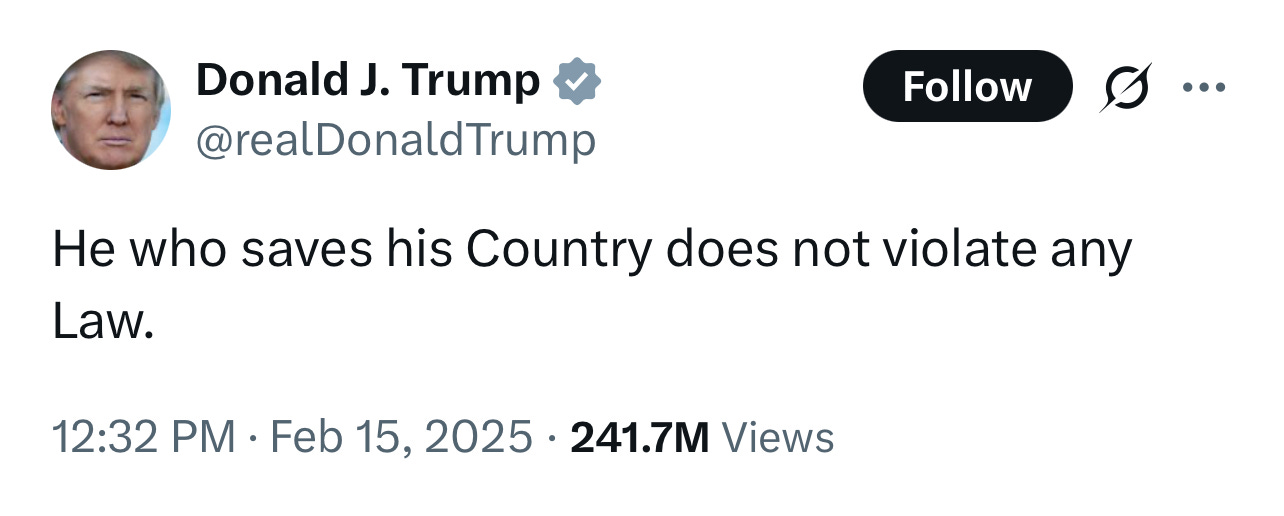
“He who saves his Country does not violate any Law,” is Trump’s way of saying that he can substitute his judgment for the courts, for the Congress, and for the law. But that’s not how it works. If one person’s whims become the law, then he is a king or a dictator, and his power is by force and not by agreement of the people. Courts are an institution—not a single person—and there’s good reason for that.
Since Trump believes his word is law, his administration has decided that they no longer wish to be bound by the rules, and hence by court orders. There are at least half a dozen court orders (not just in immigration) that the Trump administration is presently violating, including two Supreme Court decisions.
This is a major departure from past presidencies. As the Fourth Circuit recently wrote in its opinion denying the Trump Administration’s appeal in the Abrego Garcia case,
It is in this atmosphere that we are reminded of President Eisenhower’s sage example. Putting his “personal opinions” aside, President Eisenhower honored his “inescapable” duty to enforce the Supreme Court’s decision in Brown v. Board of Education II to desegregate schools “with all deliberate speed.” Address by the President of the United States, Delivered from his Office at the White House 1-2 (Sept. 24, 1957); 349 U.S. 294, 301 (1955). This great man expressed his unflagging belief that “[t]he very basis of our individual rights and freedoms is the certainty that the President and the Executive Branch of Government will support and [e]nsure the carrying out of the decisions of the Federal Courts.” Id. at 3. Indeed, in our late Executive’s own words, “[u]nless the President did so, anarchy would result.” Id.
Abrego Garcia v. Noem, 8:25-cv-00951 (D.Md, Apr 17, 2025), ECF No. 88.
And yet, a week later, not only has the Trump administration refused to comply (in this case, and in others), it has mounted a disinformation campaign in the court of public opinion to convince Americans that Trump is their savior from violence, only legitimate authority for truth and justice, and the source of law.
That this is dangerous to the freedom and prosperity of all people in the United States should be self-evident.
What can the courts do?
The courts can make orders. And when their directives are not followed, they can hold the violators in contempt.
Contempt comes in two flavors: civil and criminal.
Civil contempt’s main focus is on compelling compliance. For example, if someone refuses to answer a lawful question on the stand, the court may order them to do so. If they still refuse, the court can fine them daily, or put them in jail, until they comply. Once they comply, the contempt is resolved and the fines or detention cease.
On the other hand, criminal contempt’s focus is on punishment. The crime is prosecuted in a trial. The convicted contemnor may be fined or put in jail for up to six months. Compliance after the contempt does not prevent punishment.
President Trump is likely immune from any contempt actions, and the courts are unlikely to try it. It is up to the Congress to impeach the President for failing to “take Care that the Laws be faithfully executed,” as required by the Constitution, art. II, § 3.
But his deputies, cabinet, lawyers, and civil servants have no such protections. They can be held in contempt. They can be fined. They can be jailed. So, too, can the United States departments be fined. And while a criminal conviction of contempt can be pardoned by Trump, he has no such pardoning powers over civil contempt.
And so this is where we now find ourselves. The trial courts are gearing up to make contempt orders, and the Supreme Court and Appellate Courts are admonishing Trump to not play brinksmanship games with the third branch in hopes of avoiding it.
Trump isn’t heeding their warnings. Civil contempt looks likely in Maryland in the Abrego Garcia case. Criminal contempt has already been charged in the DC district court. And a number of other courts have requests for contempt hearings by aggrieved plaintiffs that are proceeding through due process. (By the way, the United States and its agents are all entitled to due process, just like the people they have denied it are, and that’s why this takes so long.)
You and what army?
When members of the Trump administration are held in contempt, who will enforce the judgment? Fines can be enforced by levies and attachments, and the US Marshal Service isn’t usually needed. But jailing requires a jail and a jailor. The Department of Justice controls both. And the DOJ is controlled by the executive (ie Trump, and his Attorney General Pam Bondi).
The US Marshals are employed by the DOJ even though they work within the courts. They are charged by law with enforcing court orders, and take an oath to do so (along with enforcing the Constitution). If the Marshals are ordered by AG Bondi to ignore the orders, they will have to choose between the illegal directive from their superior and their duty. What they will do remains to be seen.
The courts have a failsafe. If the DOJ and the Marshals won’t cooperate, the judicial branch has the power to deputize other enforcement officers and jails who operate outside the DOJ.
Of course, when this eventuality comes to pass within the next month, we are talking about a power struggle between the executive and the judicial branch which, at best, “promises to diminish both.” Abrego Garcia v. Noem, 8:25-cv-00951 (D.Md, Apr 17, 2025), ECF No. 88.
At worst, we are talking about a civil war in which Americans (civilian, law enforcement, and military) choose sides and take up arms against one another.
A civil war would determine who rules the jungle, but at the cost of our civilization.
One hopes that Trump’s better nature will stop him from leading us to the precipice. But I have somewhat more faith in the American people refusing to follow him over the cliff when he swan dives off it. While a percentage of our population reveres him enough to support him as king, most Americans still believe in the Constitution, our rule of law, and our freedom from monarchs.
At least, I hope so.
Thanks for reading Posts From the Edge.
If you’d like to support the research and time that goes into my writing, you can drop a tip in my Ko-fi jar. It’s never expected, but always appreciated.